If you've ever needed to get heavy materials delivered to a construction site — and there's no forklift waiting on the other end — you've probably run into a problem. Standard delivery trucks drop goods at the kerbside. Getting pallets of bricks, scaffolding frames, or plasterboard from the kerbside to where you actually need them is a whole other challenge.
That's exactly the problem a truck-mounted forklift delivery solves. Here's how it works, who uses it, and whether it's the right solution for your next job.
What Is a Truck-Mounted Forklift?
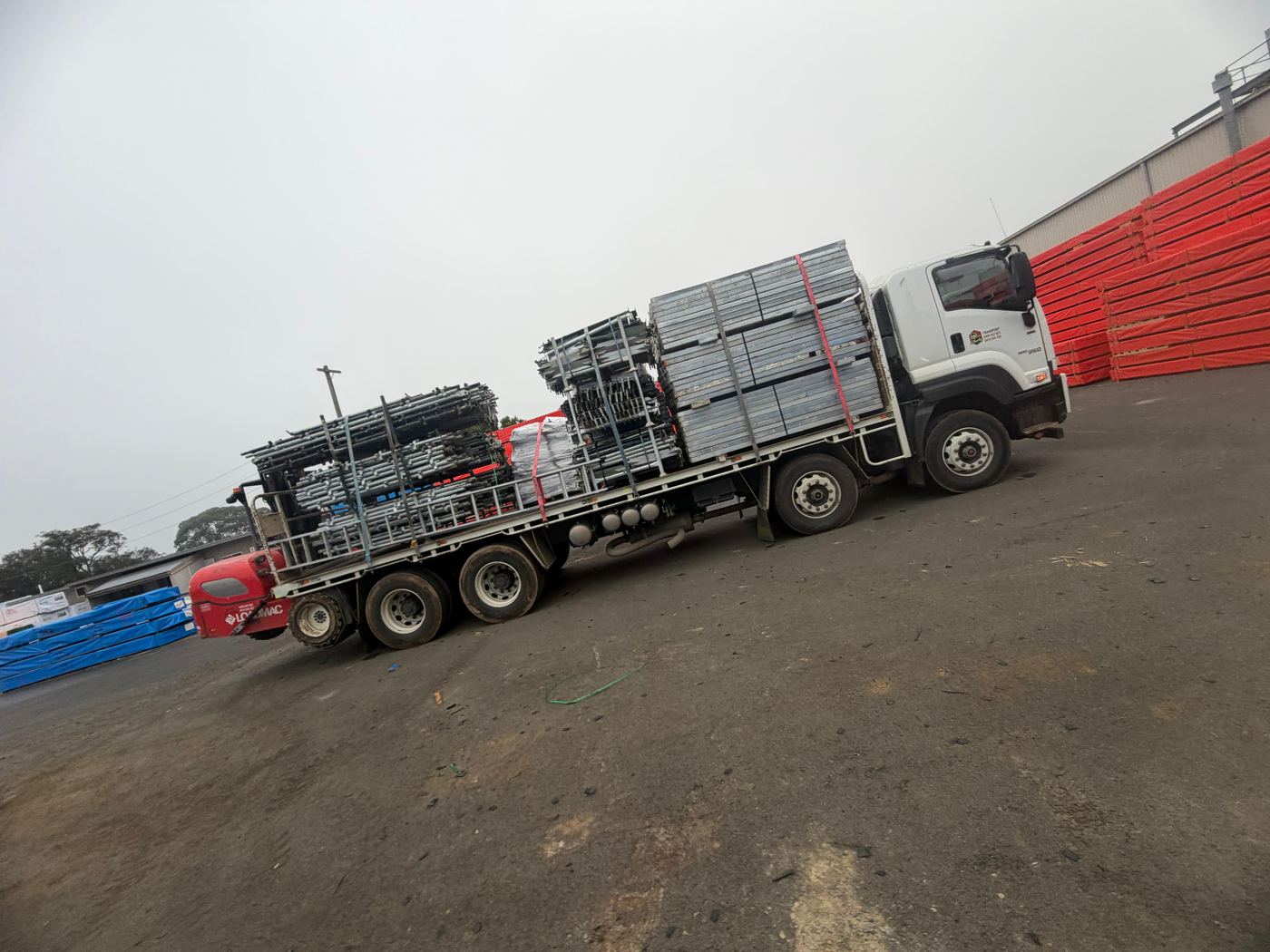
A truck-mounted forklift — sometimes called a piggyback forklift or buddy forklift — is a compact forklift that travels attached to the rear of a delivery truck. When the truck arrives at its destination, the driver dismounts the forklift, uses it to unload the goods and place them exactly where they're needed, then remounts it on the truck before driving away.
The key difference from a standard delivery: the truck brings its own forklift. You don't need to hire a separate machine, have one waiting on site, or arrange a crane. One vehicle handles everything — loading, transport, and placement.
In plain terms: It's a delivery truck with a forklift strapped to the back. When it arrives, the driver unloads your goods and places them exactly where you need them — then drives away with the forklift still attached.
How Does the Delivery Process Work?
A typical truck-mounted forklift delivery follows these steps:
- Pickup: The driver uses the truck-mounted forklift to load your goods at the pickup location — warehouse, supplier, or depot.
- Transport: Goods are secured on the truck and transported to the delivery address.
- Arrival: The driver assesses the site — surface conditions, access points, obstructions.
- Unloading: The forklift is driven off the truck and used to unload and place goods precisely where required.
- Remount: The forklift is driven back onto the truck. Job done.
The entire process is handled by a single licensed operator. No crane crew. No site forklift hire. No waiting for a separate vehicle.
What Types of Goods Can It Deliver?
Truck-mounted forklifts are suited to any palletised or heavy load that needs precise placement. Common uses in Melbourne include:
- Scaffolding components — frames, planks, props, ledgers, base jacks
- Construction materials — bricks, hebel blocks, plasterboard, tiles, pavers, roof tiles
- Solar panels and renewable energy equipment
- Imported goods requiring last-mile delivery from port or warehouse
- Landscaping materials — pavers, retaining wall blocks, sand bags
- Timber, steel, and building supplies
- General palletised freight where the delivery site has no unloading equipment
When Do You Actually Need One?
Not every delivery needs a truck-mounted forklift. Standard trucks with tailgate lifters handle many deliveries just fine. But there are specific situations where a truck-mounted forklift becomes the only practical option:
1. Active Construction Sites
Construction sites mid-build rarely have a permanent forklift on site. If you're receiving scaffolding, materials, or supplies during the build phase, a truck-mounted forklift means your delivery arrives and gets placed — without interrupting the site or hiring equipment separately.
2. Tight Access or Urban Locations
Inner-city Melbourne, laneways, narrow suburban streets — standard delivery vehicles often can't manoeuvre to unload. The compact all-terrain design of a truck-mounted forklift handles surfaces and access points that larger machines can't reach.
3. No Forklift on Site
Residential builds, small commercial projects, and many industrial sites simply don't have a forklift on site. Rather than hiring one separately — with all the associated cost and scheduling — a truck-mounted forklift delivery includes the unloading as part of the service.
4. Uneven or Rough Ground
All-terrain truck-mounted forklifts are designed for rough, gravel, and uneven surfaces. Warehouse forklifts only operate on smooth, flat ground. For outdoor site deliveries, the all-terrain capability is critical.
Quick rule of thumb: If you're asking "how will I unload this when it arrives?" — a truck-mounted forklift delivery is probably your answer.
How Is It Priced?
Truck-mounted forklift delivery in Melbourne is typically priced on an hourly rate, with a minimum number of hours. Pricing depends on truck size — small (1–4 pallets), medium (5–8 pallets/up to 8 tonne), or large (9–12 pallets/up to 14 tonne). Regional deliveries carry a fuel levy on top of the hourly rate.
Because one vehicle replaces both a delivery truck and a separate forklift hire, the total cost is often lower than organising the two separately — especially when you factor in the time saved on site.
What Should You Look for in a Provider?
When comparing truck-mounted forklift delivery services in Melbourne, look for:
- Licensed operators — the driver should hold both truck and forklift licences
- All-terrain capability — essential for construction site and outdoor deliveries
- Experience with your goods type — scaffolding, for example, requires specific knowledge of weights and stack heights
- Transparent pricing — hourly rates, minimum hours, and any fuel levies or toll charges should be clearly stated upfront
- Service area coverage — confirm they service your delivery suburb, including regional areas if needed
Frequently Asked Questions
Need a Truck-Mounted Forklift Delivery in Melbourne?
Liberty Transport Victoria specialises in scaffolding delivery and construction materials across Metro Melbourne and Regional Victoria. One truck. One driver. Your goods placed exactly where you need them.
⚡ Get an Instant Quote 📞 1300 133 4279