Tight access deliveries are one of the most common headaches for Melbourne builders and scaffolding companies. The materials are ready. The truck turns up. And then — the driver can't get close enough to unload, and suddenly you have a problem that stops the whole job.
Melbourne's urban environment makes this particularly common. Narrow inner-city streets, active construction sites with restricted access, residential laneways, and sites surrounded by fencing all create delivery challenges that standard trucks simply aren't equipped to handle.
Here's what you need to know about tight access delivery in Melbourne — and how to make sure it doesn't become your problem.
What Makes a Site "Tight Access"?
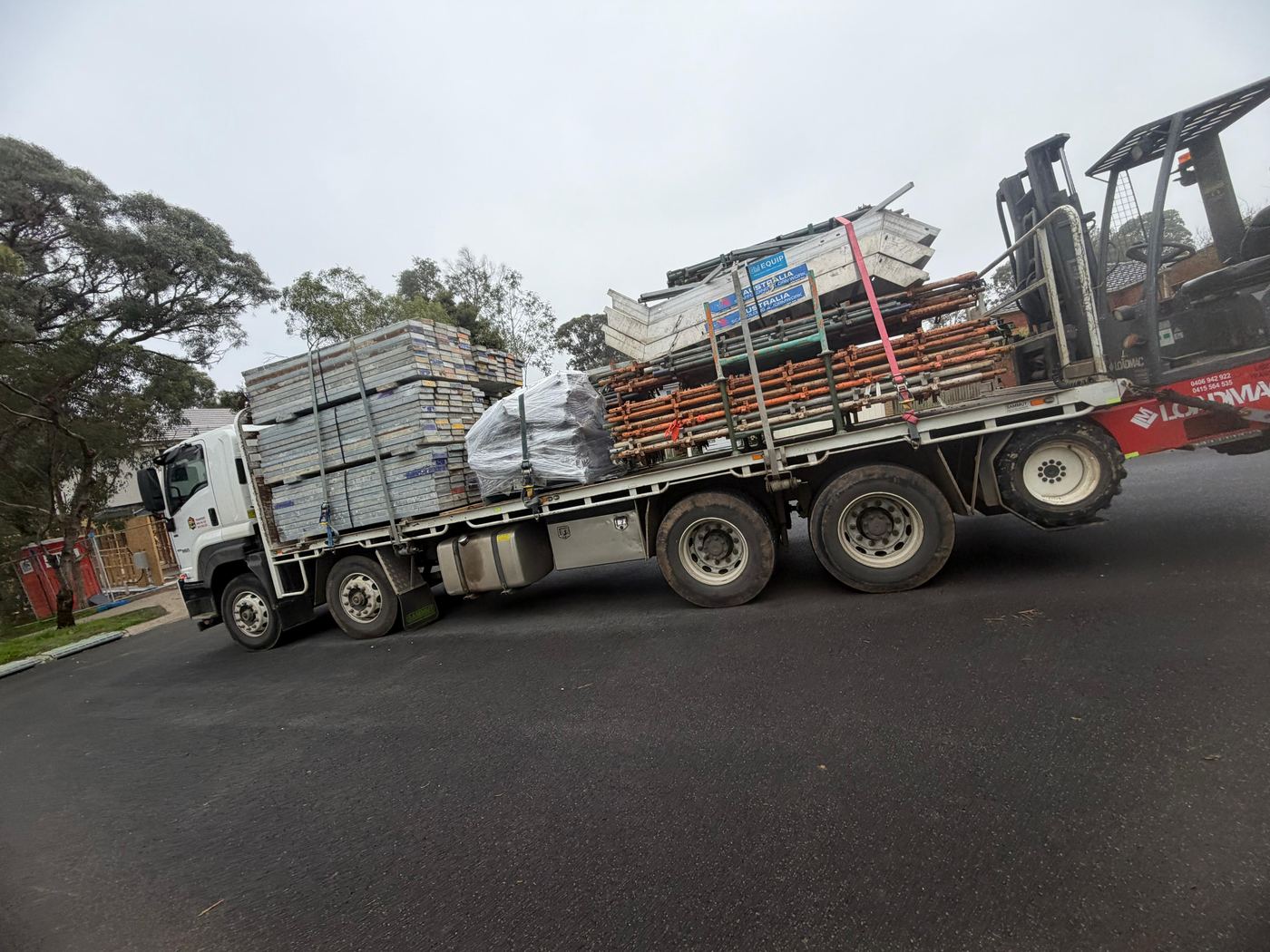
Tight access isn't just about narrow streets. In Melbourne's construction context, a tight access site is any delivery location where a standard truck cannot pull up, open its rear doors or tailgate, and unload safely without additional equipment or significant manoeuvring.
Common tight access scenarios include:
🏙️ Inner-City Streets
Narrow one-way streets in Fitzroy, Collingwood, Richmond, Brunswick — parked cars, trams, and limited stopping space make standard unloading impossible.
🏗️ Mid-Build Construction Sites
Active sites are surrounded by hoardings, scaffolding, and temporary fencing. Access is through a single gate — often barely wide enough for the truck itself.
🏘️ Residential Laneways
Rear-access builds and extensions accessed via narrow residential laneways in Melbourne's inner suburbs. Often too narrow for large trucks to manoeuvre.
🌾 Uneven Ground
Sites where the ground surface is gravel, dirt, or uneven — standard warehouse forklifts can't operate on these surfaces.
Why Standard Trucks Struggle With Tight Access
A standard rigid truck or semi-trailer needs space to pull up parallel to the delivery point, open its rear, and either use a tailgate lifter to lower pallets to kerb level or wait for a site forklift to unload from the rear. On a tight access site, none of these options work reliably:
- Tailgate lifters lower goods to ground level — useless if the ground is uneven or if goods need to be placed inside the site perimeter
- Site forklifts often aren't available during early build phases
- Semi-trailers physically cannot turn into many inner Melbourne streets
- Parking restrictions prevent stopping long enough to unload on busy roads
The result is either a failed delivery, goods left on the footpath, or damage caused by manual handling of materials that should have been moved mechanically.
How Truck-Mounted Forklifts Solve the Problem
A truck-mounted forklift is specifically designed for this situation. The compact all-terrain forklift that rides on the rear of the truck can:
- Operate on gravel, dirt, and uneven ground that warehouse forklifts can't handle
- Access sites through a single gate or narrow entrance
- Place goods precisely inside the site — not just at the kerb
- Work in areas where larger machinery can't manoeuvre
- Unload and return to the truck without needing site equipment
Key advantage: The truck-mounted forklift goes where the delivery needs to go — not just where it's convenient for the truck to stop. If you can get the truck to the street, the forklift handles the rest.
What to Tell Your Delivery Provider
When booking a tight access delivery in Melbourne, the more information you give upfront, the better. Tell your provider:
- Street width — can a standard truck park without blocking traffic?
- Site entrance width — is it wide enough for a forklift to enter, or does placement need to happen from the street side?
- Ground surface — sealed road, gravel, dirt, concrete slab?
- Overhead restrictions — power lines, awnings, or scaffolding at the access point?
- Parking availability — can you arrange a clearance zone or council permit for the delivery window?
- Time restrictions — site induction requirements, noise restrictions, or build activity that might restrict delivery times?
A good delivery provider will work through these details with you before the job, not discover them on arrival.
Melbourne Suburbs Where Tight Access Is Most Common
Based on delivery experience across Melbourne, the suburbs where tight access is most frequently a factor include:
- Inner North: Fitzroy, Collingwood, Brunswick, Northcote, Preston
- Inner East: Richmond, Hawthorn, Kew, Camberwell
- Inner West: Footscray, Yarraville, Seddon, Williamstown
- Inner South: South Melbourne, Port Melbourne, Albert Park, St Kilda
- CBD Fringe: Any delivery within 5km of the Melbourne CBD
This doesn't mean deliveries in these areas are impossible — it means they require a provider with the right equipment and experience to handle them properly.
Tips to Make Your Tight Access Delivery Go Smoothly
- Book in advance — tight access jobs sometimes require a pre-site assessment or council permit for a parking clearance zone. Last-minute bookings leave no time to arrange this.
- Arrange a clearance zone if needed — Melbourne City Council and most inner-suburb councils offer temporary no-parking permits for deliveries. A 10-metre clearance zone can make the difference between a smooth delivery and a failed one.
- Have someone on site — a site contact who can direct the driver and clear the placement area speeds the job up significantly and reduces waiting time (which you're paying for hourly).
- Clear the path — if goods need to be placed inside the site, ensure the path from the gate to the placement area is clear of debris, other materials, and personnel.
- Be realistic about access — if a street genuinely can't accommodate any truck, consider a nearby staging point where goods can be transferred. Your delivery provider can advise on options.
Frequently Asked Questions
Tight Access Delivery Specialists — Melbourne & VIC
Liberty Transport Victoria handles the deliveries other trucks can't. All-terrain Moffett forklift, experienced operators, and a track record on Melbourne's toughest access sites.
⚡ Get an Instant Quote 📞 1300 133 4279